
Table of Contents
- How to Choose a Chair for Office Work in 2026
- Comparison Table: Four Office Chairs at a Glance
- What Makes a Genuinely Ergonomic Office Chair
- The Best Office Chair for Back Support: What to Look For
- Why an Adjustable Office Chair Fits More People
- The Best Office Chair for Long Hours and Shift Work
- How Much Should You Spend on a Chair for Office Use?
- Conclusion: Matching the Chair to the Work
- Frequently Asked Questions
Last Updated: October 4, 2026
How to Choose a Chair for Office Work in 2026
Choosing a chair for office work comes down to four measurable specifications: seat height range, lumbar support adjustability, seat depth, and backrest recline. Get those right and most discomfort disappears. Get them wrong and no amount of padding will save you.
At THATSMYOFFICE, we have spent over 30 years sourcing seating from British manufacturers, and the pattern is consistent: buyers who measure first rarely return their chairs. Those who buy on looks alone usually do.
This guide covers what actually separates a good chair for office use from an expensive mistake, including how much to spend and which specification matters most for back support.
The Four Specs That Decide Everything
Seat height, seat depth, lumbar support, and backrest recline determine whether a chair fits a person or merely accommodates them. Everything else, from armrests to headrests, is refinement.
Here is what to check before you buy:
- Seat height: your feet should rest flat on the floor with thighs roughly parallel to it. A gas lift covers most users; shorter or taller people need a wider range.
- Seat depth: two to three fingers of clearance between the back of your knee and the seat edge. Too deep and you slump forward to compensate.
- Lumbar support: the curve should sit in the small of your back, not above it. Adjustable height matters more than fixed padding.
- Recline: a backrest that moves and locks lets you change posture through the day, which reduces sustained loading on any one part of the spine.
A common mistake is treating these as luxury features. They are the specification.
Comparison Table: Four Office Chairs at a Glance
The four chairs below cover the main buying scenarios: everyday task work, long-shift use, posture correction, and budget-conscious bulk purchasing.
| Chair | Price | Key Adjustment | Best For |
|---|---|---|---|
| Eclipse Plus II Mesh Back Operator Chair | £110.00 | Twin lever gas lift and backrest tilt | Everyday operator and home office use |
| X.66 Operator Chair Mesh Back | £200.00 | Self-weigh mechanism, seat slide, 3D armrests | Mixed-height teams sharing desks |
| Eirgo Advanced Office Chair | £340.00 | Pump-up lumbar, seat slide, four-position lock | Long hours and shift patterns |
| Chiro Plus Posture Chair Bespoke | £604.00 | Height-adjustable backrest, seat slide, synchro tilt | Back support and bespoke upholstery |
Prices are as listed on our site. If you are equipping a floor rather than a desk, the difference between £110 and £604 per seat is the difference between a chair that survives a year of hot-desking and one that survives a decade.


What Makes a Genuinely Ergonomic Office Chair
An ergonomic office chair is one whose key dimensions adjust independently to fit the person sitting in it, rather than forcing the person to adapt to a fixed shape. Independent adjustment is the whole point.
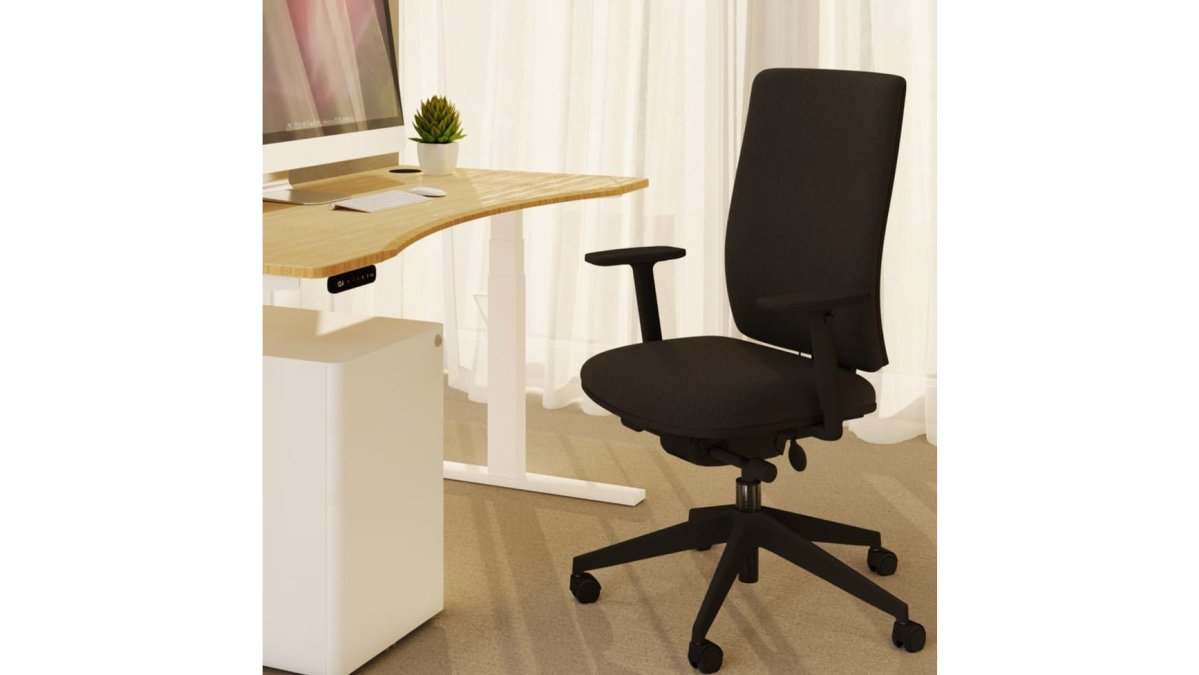
Most chairs sold as ergonomic offer one or two adjustments. Genuine ergonomic seating offers at least four working together:
- Backrest height and angle
- Seat depth, so the seat matches thigh length
- Lumbar support that can be positioned, not just padded
- Armrests that bring shoulders into a relaxed position
The Health and Safety Executive's guidance on display screen equipment sets out the principle clearly: workstations should fit the user, and seating is a core part of that assessment. For employers, that is not a nice-to-have. It is the standard against which a chair purchase gets judged.
The Best Office Chair for Back Support: What to Look For
The best office chair for back support has an adjustable lumbar section that sits in the natural inward curve of the lower spine, plus a backrest that reclines and locks. Fixed lumbar padding placed too high is the most common failure we see.
Look for these in order of importance:
- Adjustable lumbar height. Bodies differ; a fixed curve only suits one of them.
- Contoured foam or a shaped backrest. Flat backs offer no support where it counts.
- Recline with tension control. Locking upright all day loads the discs; a little movement helps.
- Seat slide. Depth adjustment keeps the lumbar support in contact with your back rather than letting you slide forward.
The Chiro Plus Posture Chair Bespoke was designed around this brief, with a height-adjustable backrest, fixed lumbar support, contoured foam, a seat slide, and a triple-lever synchro tilt mechanism. It supports up to 150kg and is upholstered to order.
Where a chair falls short is weight and footprint. At this specification it is a substantial piece of furniture, and it suits a dedicated desk rather than a room that doubles as a dining table.
Why an Adjustable Office Chair Fits More People
An adjustable office chair fits more people because a single frame can be configured to a range of body sizes, which matters when desks are shared or staff turnover is high. One specification covers a whole team.
That is the practical argument for adjustability over buying "the right size" in bulk. A self-weigh mechanism, like the one on the X.66 Operator Chair, sets tension automatically based on the user's weight, so a heavier and a lighter colleague get sensible resistance without touching a dial.
Chiro Plus Ergonomic Office Chair Posture seating for home or office →
For procurement, the maths is straightforward:
- Standardised chairs reduce the number of specification variants you hold
- Fewer variants mean simpler replacements and spares
- Adjustable seating suits hot-desking, where any chair may be used by any person
The X.66 also offers a seat slide, 3D armrests, and adjustable lumbar support. Stock items typically arrive in three to five days; bespoke builds take three to four weeks.
The Best Office Chair for Long Hours and Shift Work
The best office chair for long hours is one rated for continuous use, with a mechanism that lets you change position without leaving the seat. Duty rating matters more than padding at this end of the market.
Most task chairs are built around an eight-hour working day. Chairs intended for control rooms, shift patterns, and 24-hour operations are tested and rated differently, and the Eirgo Advanced Office Chair is specified for extended use.
What makes the difference over a long shift:
- Pump-up lumbar support, so you can increase or reduce pressure as the day progresses
- Seat slide, which changes the contact point between seat and thighs
- A four-position locking mechanism with tension adjustment, letting you alternate between upright and reclined
- Ratchet back and step arms, for quick repositioning without tools
Twenty-four-hour rated seating is not a marketing label. It reflects the mechanism and foam being chosen to cope with near-continuous loading rather than a standard office day.
How Much Should You Spend on a Chair for Office Use?
Spend according to hours of daily use, not seniority or desk position. A chair sat in for eight hours a day justifies several times the spend of one used for an hour of admin.
A workable banding for planning purposes:
- Light and intermittent use: entry-level task chairs, around £110
- Everyday full-day use: mid-range chairs with seat slide and adjustable lumbar, around £200
- Extended and shift use: higher-specification seating rated for continuous use, around £340
- Posture-focused and bespoke: specialist seating with full adjustment and custom upholstery, around £604
The Chartered Institute of Personnel and Development's research on health and wellbeing at work consistently finds musculoskeletal complaints among the most common reasons for sickness absence. A chair is one of the cheapest interventions available against that.
For larger projects, we offer outright purchase or lease, plus optional professional installation, which matters when a delivery has to become a working floor rather than a stack of boxes in a corridor.
Conclusion: Matching the Chair to the Work
The chair that suits a hot-desking floor is not the chair that suits a night-shift control room, and treating them as the same purchase is where most budgets go wrong. Match the specification to the hours, the sharing pattern, and the people.
At THATSMYOFFICE, we stock seating from British manufacturers with 360-degree product views, fast delivery, flexible purchase or lease options, and installation services if you need them. We are an independent retailer, so our advice is not tied to a single factory.
Contact us with your floor plan and headcount, and we will help you match the right chair for office use to each space.
Frequently Asked Questions
What should I look for when buying a chair for office use?
Prioritise four things: seat height range, lumbar support, seat depth and weight rating. A chair that supports up to 150kg, such as the Chiro Plus Posture Chair Bespoke at £604, handles heavier users without strain. Check the backrest adjusts independently of the seat, and confirm the mechanism locks in more than one position. If you share the chair, a seat slide matters more than a headrest.
Are ergonomic office chairs worth the extra cost?
It depends on hours of use. For two hours a day, a £110 operator chair like the Eclipse Plus II covers the basics. Past six hours daily, the adjustments on a £340 Eirgo Advanced Office Chair, including pump-up lumbar support and a four-position locking mechanism, let you change posture through the day rather than sitting in one fixed position. That adjustability is what you are paying for.
Which is the best office chair for long hours?
Look for a chair rated for extended or 24-hour use, with adjustable lumbar support and a seat slide. The Eirgo Advanced Office Chair is built for this, with 6cm of foam in the seat and a ratchet back. The X.66 Operator Chair at £200 also suits long shifts, with a self-weighing mechanism and 3D armrests, and stock models arrive in three to five days.
How do I adjust an office chair for good posture?
Set seat height so your feet sit flat and knees are level with your hips. Slide the seat so two to three fingers fit between the back of your knees and the seat edge. Set lumbar support into the small of your back, then adjust armrests so shoulders stay relaxed. Recline slightly and set tension so the backrest supports you without pushing you forward.



0 comments